NORTH WALES COAST
RAILWAY :NOTICE BOARD
Rheilffordd arfordir gogledd Cymru: Hysbysfwrdd

Uploaded:
28 September 2026
Next upload
12 October 2026
Link to the previous issue
Link to this issue
RSS Feed
Archive

Coming Events
For details visit our Calendar page
19-20 September Bala Model Railway Show
Saturday 19 September Northern Belle "Settle & Carlisle Steam Special", Wrexham General and Chester to Carlisle. WCRC steam locomotive over the Settle & Carlisle line. Diesel hauled otherwise.
October 2026
Thursday 1 October Clwyd Railway Circle 'The view from a signal box window' Adrian Bodlander
Friday 9 October: Altrincham Electric Railway Preservation Society Lee Stanford "The Norman Harrop Collection Part 1. A selection of photographs from the Manchester Locomotive Society archive of 1960s steam in the North West of England taken by Norman Harrop".
14 October. Welsh Highland Railway North Wales Group. Dave Kent – '"Here's one you might recall...?" Dave will give his perspective of rebuilding the WHR with a wealth of photographs to accompany his talk. He was involved from Day One and many may have also worked alongside him on it.'
November 2026
Thursday 5 November Clwyd Railway Circle "40 years of Railway in the Chester area" - Geoff Morris
11 November Welsh Highland Railway North Wales Group. Dave Waldren – ‘My View of Reconstructing the WHR.’
Friday 13 November Altrincham Electric Railway Preservation Society Tom Ingall "The Reunification of the Great Central Railway". The talk describes the plan to reunify the Great Central Railway (North) and the Great Central Railway preserved lines by building a new link in the centre of Loughborough. Tom is a BBC presenter who has been a volunteer at the Great Central Railway since the age of 14.
December 2027
Thursday 3 December Clwyd Railway Circle Ian Mainprize 'German Railway Development'
9 December Welsh Highland Railway North Wales Group – Mike Blackburn – The Chester & Holyhead Railway.
January 2027
Friday 8 January Altrincham Electric Railway Preservation Society Jeremy Nicholls "100 Years of Trains to Audlem" and "Nantwich and the Railway". Contact Andrew Macfarlane, (0161) 928 9394)
February 2027
Friday 12 February Altrincham Electric Railway Preservation Society Chris Davies "The AERPS and the Last Years of the 1500 volts dc Altrincham Electrics". Chris is a Vice-President of the Society and he has been involved since the early days in the early 1970s. Contact Andrew Macfarlane, (0161) 928 9394
March 2027
Friday 12 March Altrincham Electric Railway Preservation Society Paul Shackcloth "People and Places 9". More images of the pre-1968 steam railway with at least one person visible. Contact Andrew Macfarlane, (0161) 928 9394 for confirmation)
For up-to-date North Wales information
join the North Wales Trains News group
North Wales Coast Railway website created and compiled by Charlie Hulme
[The other items usually in this column are temporally out of service for re-construction]
.jpg)
The 'drag' of new units to have their wheels at Holyhead seen-to goes on. 29 September saw 37 884 Cepheus passing sunny Pensarn hauling 756 106 on the way back to Cardiff, where the wheel lathe is still out of action. Regarding my questions in the last issue, we are told that these units are 'dragged' because they might run out of fuel on the long journey. Picture by Gary Thomas.
News Pictures

Scene at Pwllheli on 18 September, with the new and old together. 158 832 is on the 11:37 to Machynlleth, where it will join the 11:20 to Birmingham International to where (hopefully) is reached at 16:50. Pictures by Eryl Crump.

The pair 197 029 and 197 030 are stabled between in the siding. It had been had been suggested suggested the 197s would be in regular passenger service by then. The original takeover date was September 14 but it is now understood to be sometime between October 12 and 26. During the week 197 029 was seen working the Pwllheli-Machynlleth-Pwllheli crew training runs, and 197 030 was used for static crew training at Pwllheli. On this particular day however both were showing no sign of use.
A message on 'Cambrian Railways Past & Present' Facebook suggests Transport for Wales/Trafnidiaeth Cymru (TfW/TC) are to reduce Class 158 diagrams to 10 in the latter parts of September 2026 but retaining all sets as a contingency. October 2026 shows a further reduction to eight diagrams and all 158s to be phased out and replaced by February 2027.
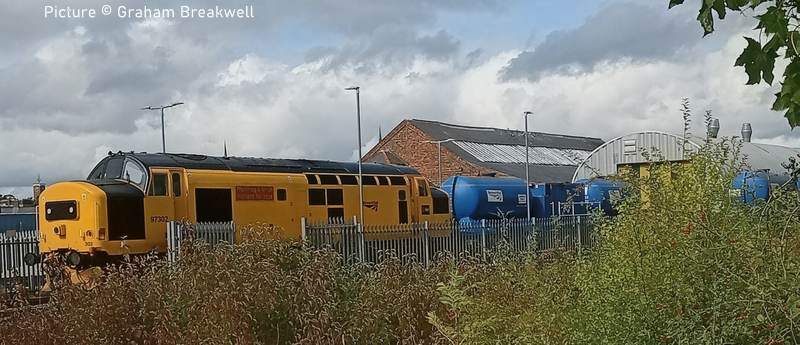
It’s that time again, when the 'leaf busters' are about to start their rounds. Above, 97 302 with a rake of six tanks at Coleham depot on 26 September. 56113 joined 97304 and 97302. There was scheduled a round trip over the usual autumn route but the service was cancelled. Maybe not enough leaves have fallen! (Graham Brakewell)
Llangollen scenes
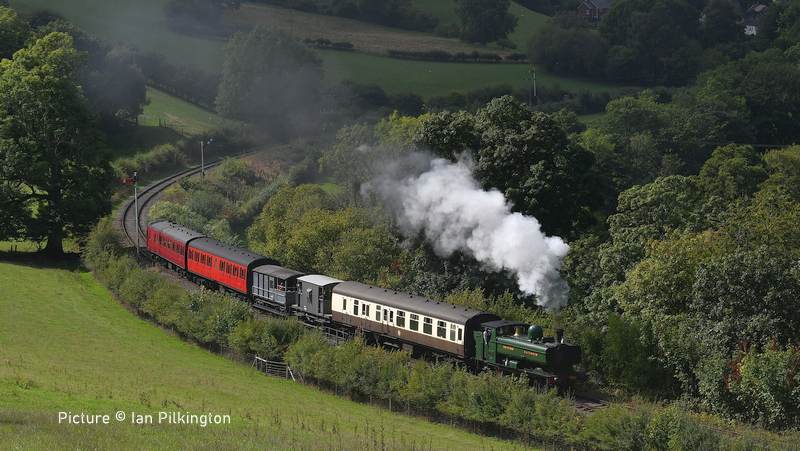
7754 heads away from Glyndyfrdwy with the 13:00 Carrog - Llangollen on Sunday 13 September.
-1.jpg)
3802 heads away from Glyndyfrdwy with the 15:15 Llangollen - Corwen on Sunday 13 September.
Notes on Holyhead - by Eryl Crump.

An unusual view of the station on Sunday 20 September. 805 003 stands in platform 1, while 67 013 and its coaches get a good brush-up.
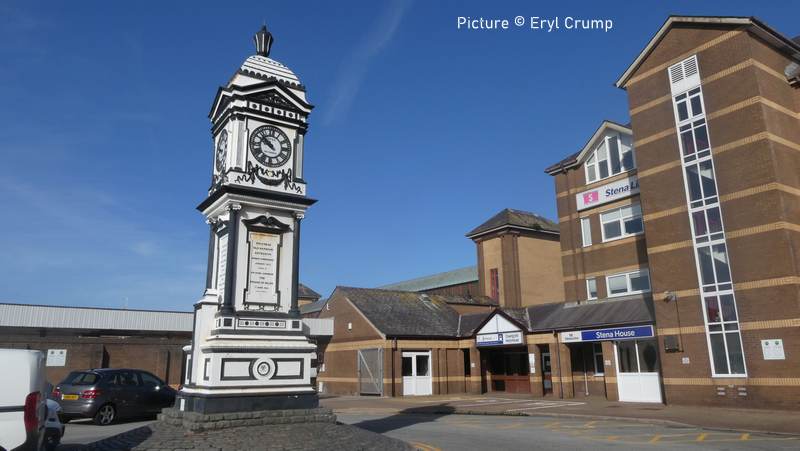
The approach to Holyhead station contains a Grade II listed clock turret which has an interesting history. It was made by J. B. Joyce & Co of Whitchurch to mark the completion of the old harbour extension.
The clock was unveiled by Albert Edward, then Prince of Wales on 17 June 1878.
Originally positioned closer to the harbour front by the old station buildings it was relocated slightly to the southern end of the station approach near the car park and Stena House. The building had been built in the preceding decade after the old hotel was demolished.
The first station in Holyhead was opened by the Chester and Holyhead Railway on 1 August 1848, but this was replaced by the second on 15 May 1851.
The present station was opened by the London and North Western Railway on 17 January 1866 and still retains its overall roof. It is believed to be the longest train shed in Wales. It originally had four platforms, but only three are currently in use, the track to the former platform 3 having been lifted except for the section in inside the shed which is set in concrete. The platform was used by mail and parcels trains; this traffic dwindled until to the platform was considered not needed. Confusingly the number 3 was transferred to the platform outside the shed, which was much-used by the legendary Class 37/4 service, as it has facility for a loco to 'run round' a train.
Tanat Valley - report by Graham Breakwell

The Tanat Valley Light Railway took part in the national Heritage Days programme last week at their Nantmawr base near Oswestry.
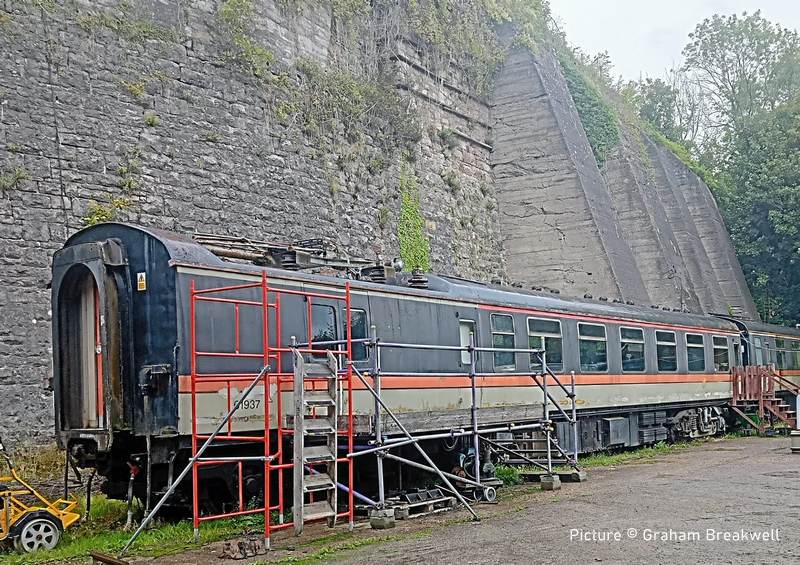
It is home to one of the 'Clacton Express' EMUs 309 616, images of two of the coaches of which are attached here. Obviously not in running order, but in use as a 'Clacton Cafe'. [309 616 is one of the units found themselves running in North West England running from Manchester Piccadilly. I travelled from my local station of Davenport. C.H.]
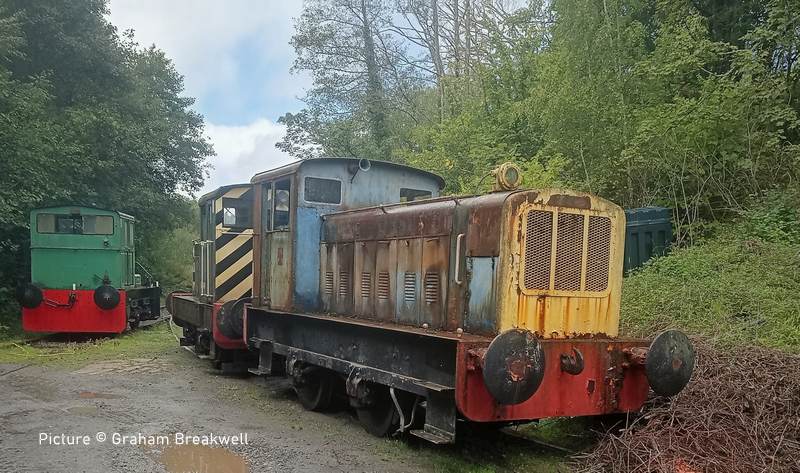
They also have a selection of shunters in varying condition ...
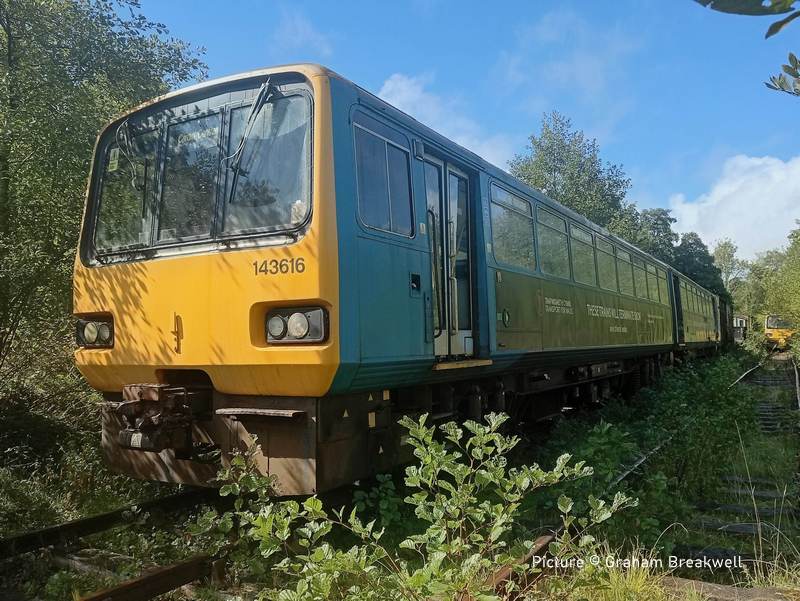
... and two Class 143 'Pacer' units. The units came from TfW, and ran in traffic with the message 'These trains will terminate soon' on the side of 143 616, much to passengers relief I’d think! The other unit is 143 601.
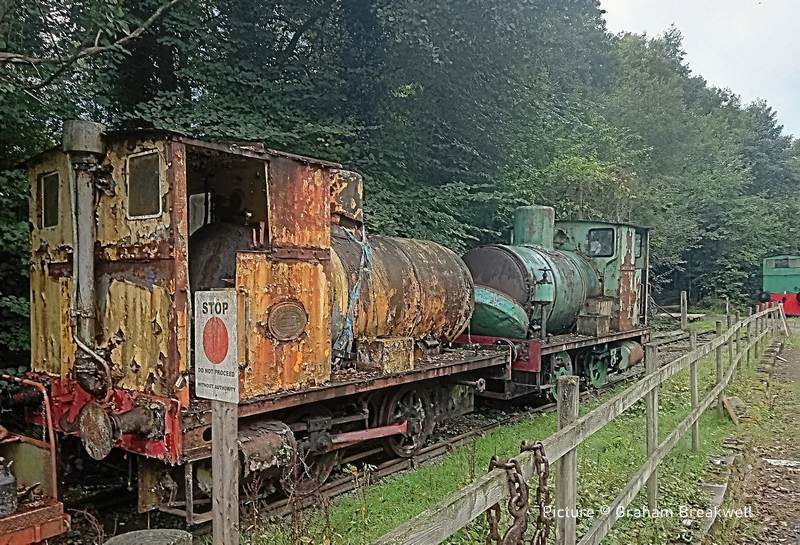
And looking very sad, a pair of 'fireless' locos from the Museum of Wales.
From Dave Sallery's Archive

45 145 on an Up Trans Pennine service at Rhyl, 8 May 1987.

37 275, Prestatyn, 2 June 1995 Oor Wullie, named after a Scottish newspaper cartoon character. This was the period when the usual 37/4s had been taken out of service to check a possible fault. 37 275 is now preserved on the Dartmouth Steam Railway.

47 196, with a Freightliner, stops for a crew change in Chester, 11 June 1985.

20 902 + 20 903 at Maentwrog Road, 17 August 1983. The annual visit of the weed-killing train to the Trawsfynydd branch.

37 415 arrives at Liverpool Lime Street with a train from Blackpool, 20 June 1992. 37 415 was cut up at CF Booth, Rotherham in November 2013.

45 106 with an Up loaded ballast at Talacre, 14 September 1987 sporting an unofficial name Vulcan by Tinsley's depot staff. The following year this loco was painted in original green livery for use on special trains, and became the last 'Peak' in traffic.
Looking
Back: 1972 part 5 - by David Pool
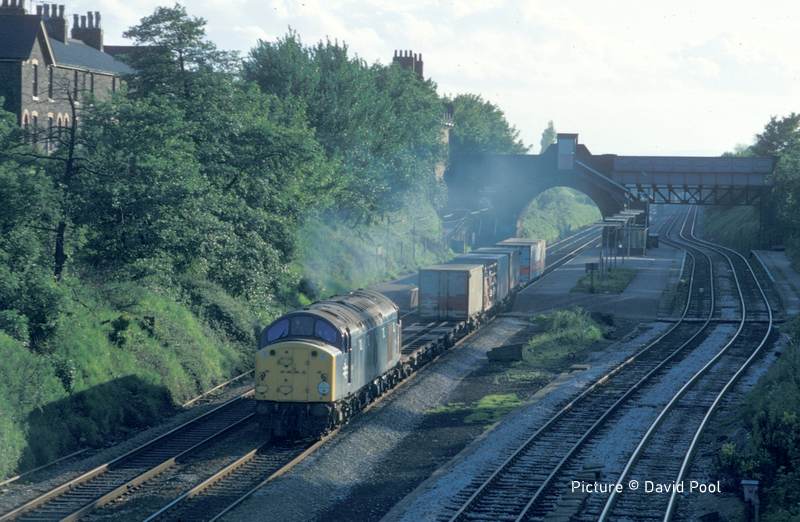
Hunts Cross
was a good photographic location, but the evening
Freightliner from Garston to Trafford Park departing at
19:20 would be in shade or darkness for most of the year.
On 19 June 1972 the Class 40 319 was still in the
sunlight as it passed though the station.
I was heading
South on holiday on 24 June 1972, and called at Bedford to
see what remained of the lines from Bletchley and
Cambridge, the latter having been closed to passengers in
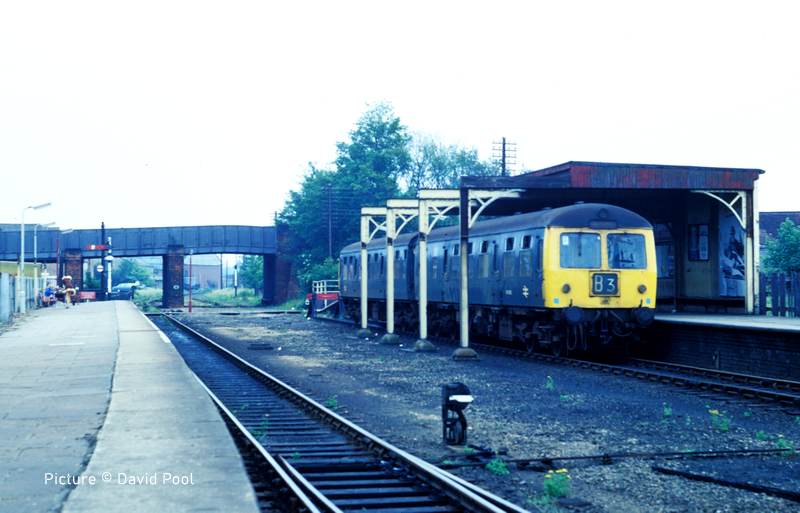
1968. At Bedford (St Johns) station the 12:00 for
Bletchley was a Cravens Class 105 M56147/M50393.
The line on the left was the connection to the main line
and Bedford station, and in 1984 the St Johns station was
resited nearer to the main line.
The line to
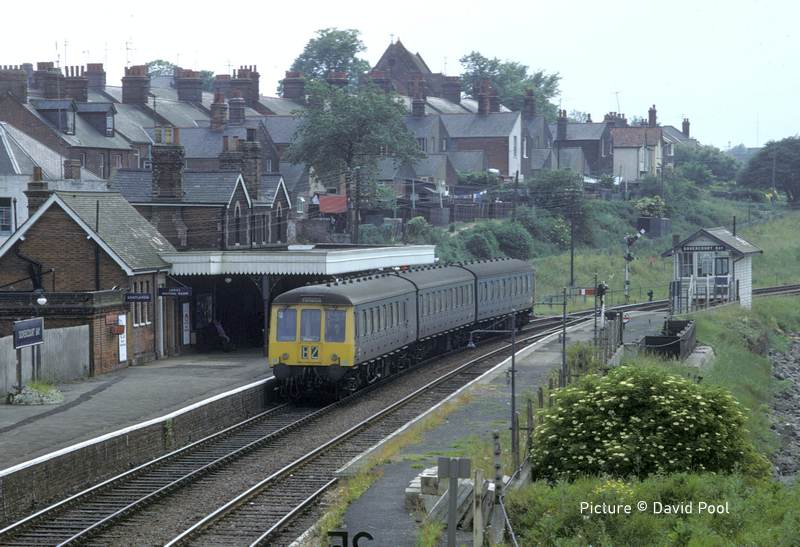
Harwich was still being used for freight to and from the
Train Ferry, and the double track from Parkeston Quay was
operated as single lines for passenger and freight
services. The 16:50 from Parkeston Quay to Harwich was a
Derby Class 116 originally from the Western Region, now E50841/E59369/E50899
and photographed at Dovercourt on 24 July 1972
Two days
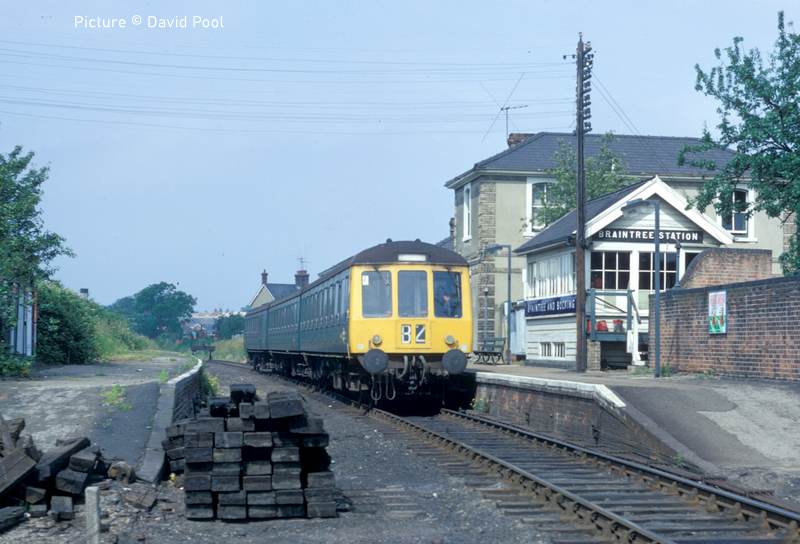
later I was in Essex, and at Braintree the station was no
longer on a through route to Bishops Stortford, being now
the end of the branch from Witham. By coincidence the unit
was the same Class 116 I had photographed two days earlier
at Dovercourt.
Although the
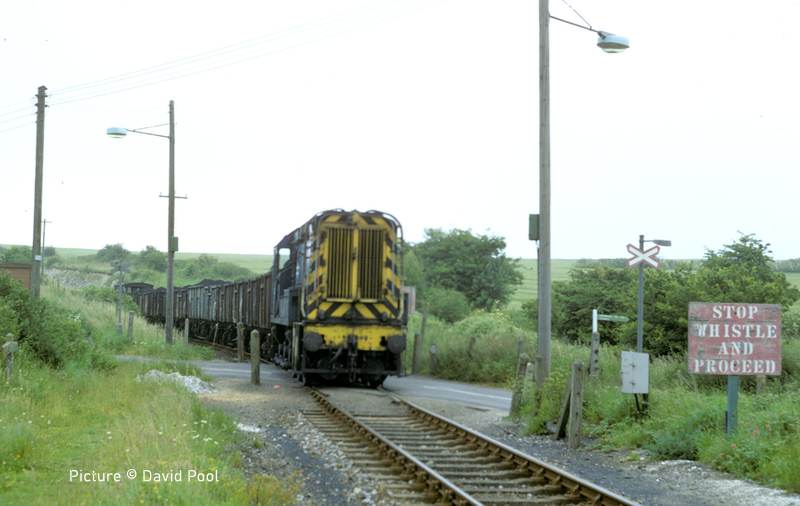
Kent and East Sussex Railway was now the in the category
of a line to be run by a preservation society, part of the
East Kent Railway was still in use by British Railways,
with freight from Tilmanstone colliery at Eythorne being
conveyed to Shepherdswell on the main line between
Canterbury and Dover. On 27 June 1972 a Class 08 3223
(later 08 155) was coming from the
colliery. I don’t remember how I found out what time it
was due, but it was worth the wait!
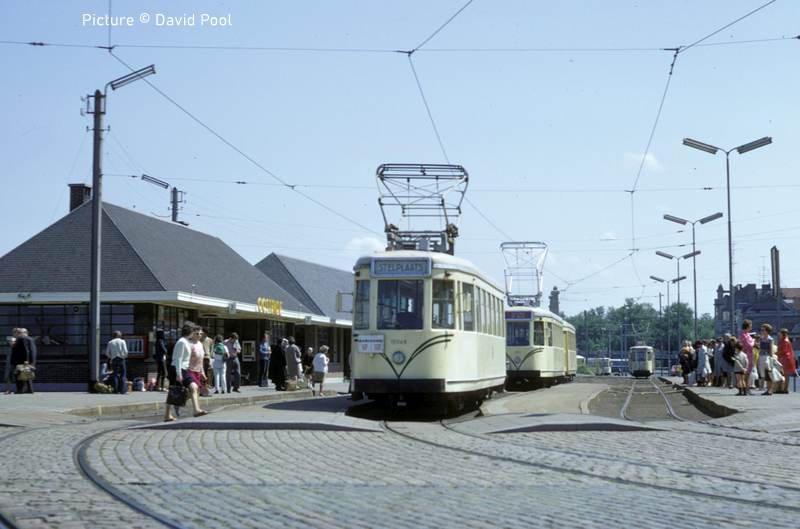
Staying at
Dover for a few days, I was tempted to go on a cheap day
trip to Ostend on 28 June 1972. I wasn’t expecting much
railway interest, but the coastal tramway was worth
seeing. This was over forty miles long and provided a very
useful service for the district. The tram stop was
adjacent to the ferry terminal at Ostend, where most of
the trams were the Type SO, such as tram 10046 in
my shot. These trams had a single driver’s cabin, since
the coastal route had turning loops at each end and at
Ostend. Like many other trams in Belgium at that time,
these “Standard” trams had been rebuilt from wooden bodied
trams dating from the 20s and 30s.
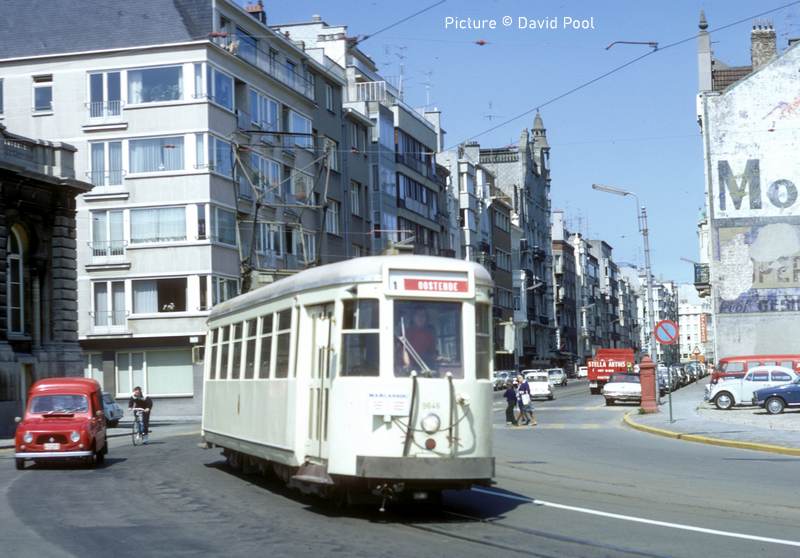
The remaining trams elsewhere in Belgium were generally
double cabin “Standard” rebuilds, able to be driven from
either end. The coastal tramway had a few of these Type S
trams for short journeys where no loop reversals were
available, and I photographed tram 9646 in
Koningsstraat.
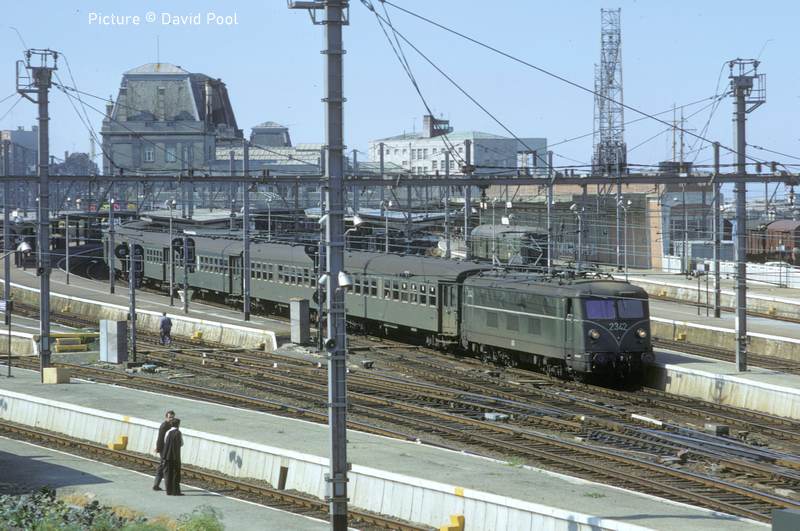
Ostend railway station had not been very busy. I saw locomotives from Classes 22, Class 25 and 26, but all at that time were very similar and in the rather dull green livery. Just before I returned to Dover on the Roi Baudouin ferry, Class 23 2342 was departing with the 15:51 to Brussels.
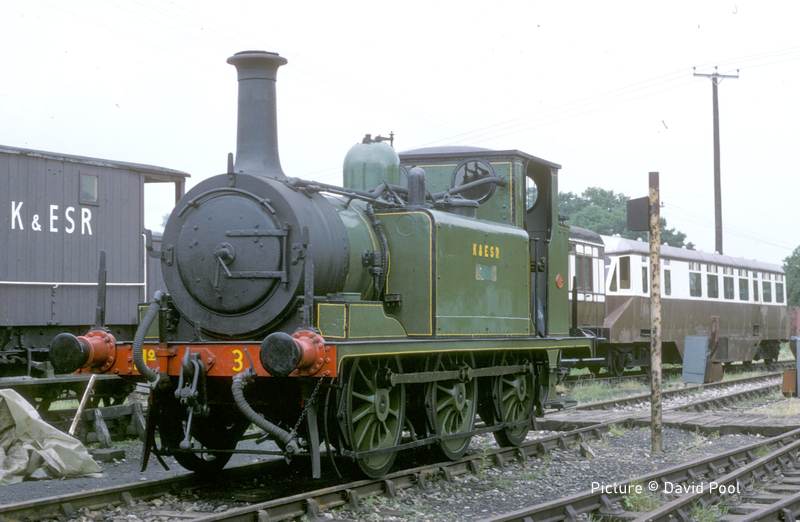
On 30 June
1972 I went to Tenterden to see how things were
progressing at the KESR. The “Terrier” 10 Sutton
was nicely posed for a shot, but not in steam.
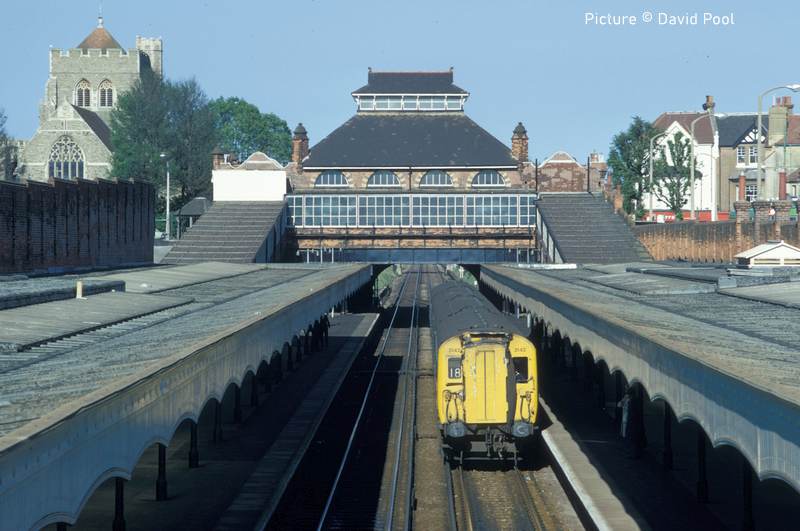
In Bexhill on
the same day the 17:42 Ore to Brighton was 4COR set 3142.
I thought the station building was more interesting than
the train, but I have now learned that 3142 is the
last surviving complete pre-War electric multiple unit, in
the care of the Southern Electric Group’s 3142 Club based
at Shepherdswell on the East Kent Railway.
My Holiday part 3 - by Charlie Hulme
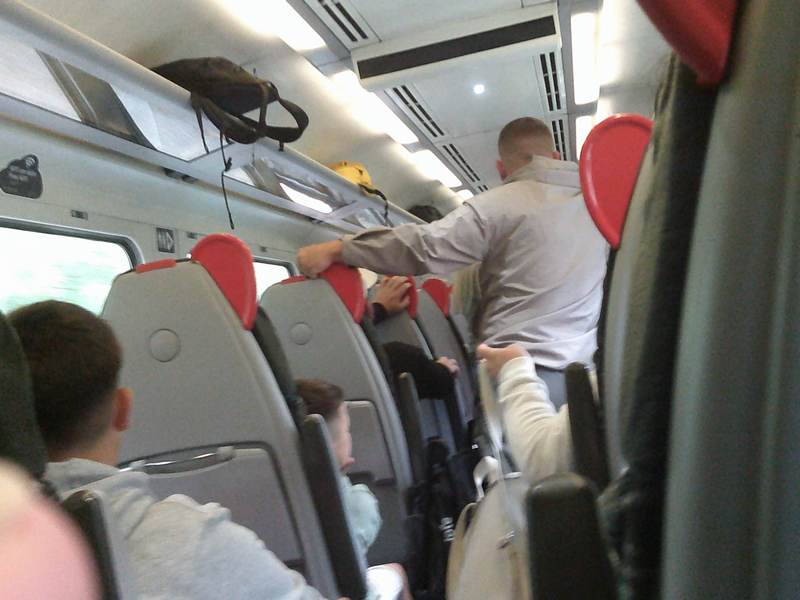
The plan was to visit the Fairbourne Railway, so first we caught a TfW train from Porthmadog to Fairbourne. The 2-car train was full by the time it reached us. No staff or ticket machines, so the conductor has issue tickets, and work the doors at stations, so he had to return to go back several times, which he did in a cheerful and successful manner. It was a very hot day, and of course the air-con wasn't much help. Anyway, we reached Fairbourne on time.
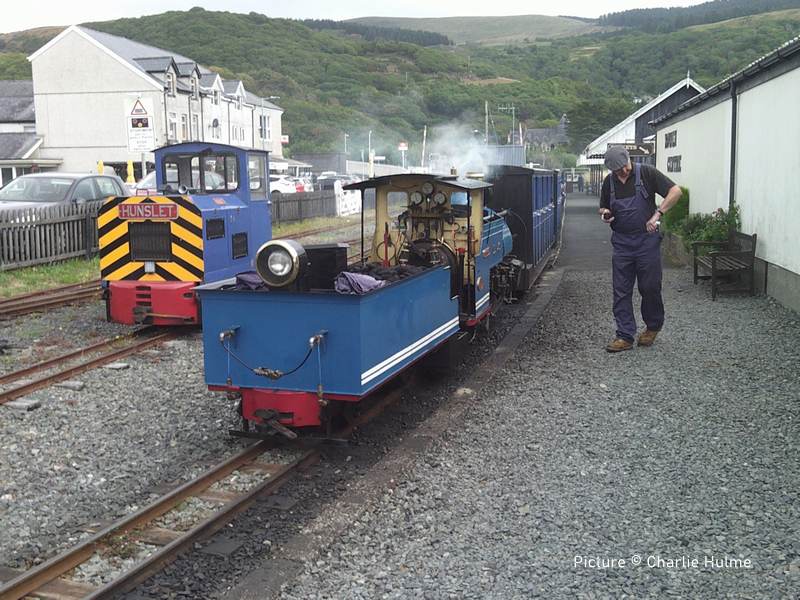
The Fairbourne Railway is really impressive. Food and drink at both ends of the line, locos and rolling stock in fine fettle, and friendly staff. The steam locos are reduced versions of a one that once ran on a Darjeeling Himalayan line in Bengal and the Lynton - Barnstaple. There are open carriages as an option. If we had time I'd like a second trip. We were there in peak time, and the locos were working in top-and-tail The ferry to Barmouth was in action - now two boats - but I always avoid this, in case I fell into the harbour at the Barmouth end.
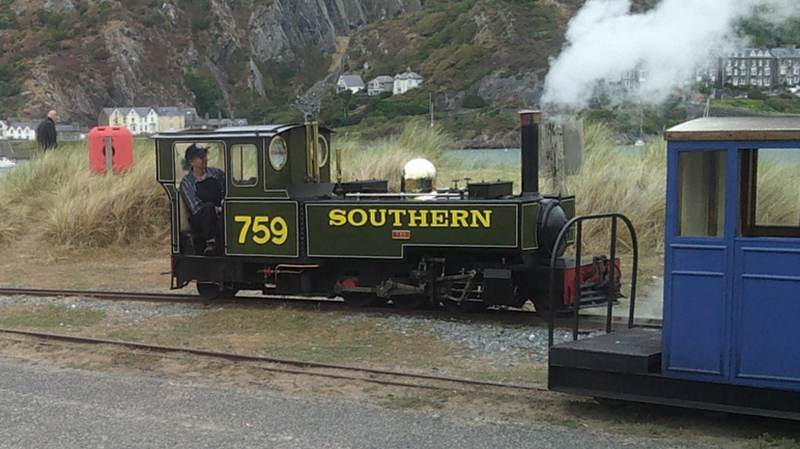
Unfortunately the return by TfW to Porthmadog at 5pm was not so impressive. Rail Time Trains told me that our train was five minutes late at Towyn, and when we arrived at Barmouth we had to wait for the train from Pwllheli had been given priority. So we had to stand at Barmouth for it to arrive from Harlech which took about 45 minutes in the hothouse of the packed train. Fancy signal systems and locos won't help this problem, only more crossing loops.
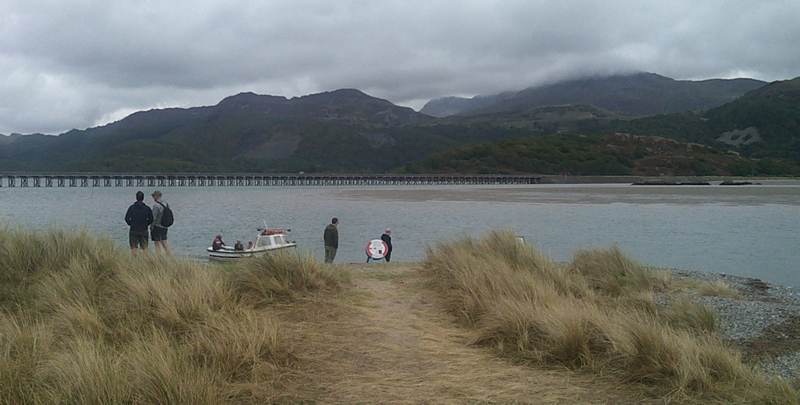
Despite all the tribulations, I'll be coming back to the Cambrian, but not in August! Will the 197s with the fewer seats, and just one toilet, prove suitable? Time will tell.
Home page | Archive | Previous Notice Board