NORTH WALES COAST
RAILWAY :NOTICE BOARD
Rheilffordd arfordir gogledd Cymru: Hysbysfwrdd
6 July 2026
Next update 20 July




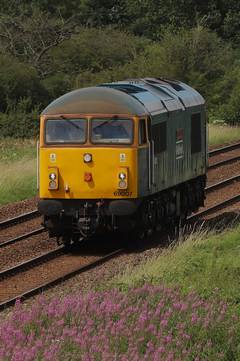
Forthcoming events
See our Calendar Page for operator details.
July 2026
Friday 3 July Saltburn Railtours Saltburn to Llandudno (one way, WCRC diesel hauled)
Monday 6 July Saltburn Railtours Llandudno to Saltburn (one way, WCRC diesel hauled)
Sunday 12 July Railway Touring Company "The North Wales Coast Express", Liverpool Lime Street to Holyhead. WCRC steam loco TBC.
Sunday 15 August Railway Touring Company "The Slate Miner", Oxford to Blaenau Ffestiniog. WCRC 57 to Bescot, with a Colas Rail 56 to Blaenau Ffestiniog and return
August 2026
Wednesday 19 August Midland Pullman "Torbay Riviera Pullman", Chester, Wrexham General, Ruabon, Chirk to Torquay and Paignton. LSL Midland Pullman HST.
29-31 August 2026 Bala Lake Railway Steam Gala
September 2026
19-20 September Bala Model Railway Show
Thursday 3 September Clwyd Railway Circle "Severn Valley Steam" Highlights of 2012 and 2013 Steam Galas - Glyn Jones
Saturday 19 September Northern Belle "Settle & Carlisle Steam Special", Wrexham General and Chester to Carlisle. WCRC steam locomotive over the Settle & Carlisle line. Diesel hauled otherwise.
October 2026
Thursday 1 October Clwyd Railway Circle 'The view from a signal box window' Adrian Bodlander
November 2026
Thursday 5 November Clwyd Railway Circle "40 years of Railway in the Chester area" - Geoff Morris
December 2026
Thursday 3 December Clwyd Railway Circle Ian Mainprize 'German Railway Development'
Belmond have advertised their 2026 three-day Britannic Explorer trips to the sidings in Barmouth, start dates are: 30 March, 13 April, 4/11/25 May, 1/8/15/22/29 June, 6/20/27 July, 3/17/21/24 August, 14/28 September, 19 October and finally 9 November.
Other useful sites:
For up-to-date North Wales information
join the North Wales Trains News group
North Wales Coast Railway website created and compiled by Charlie Hulme
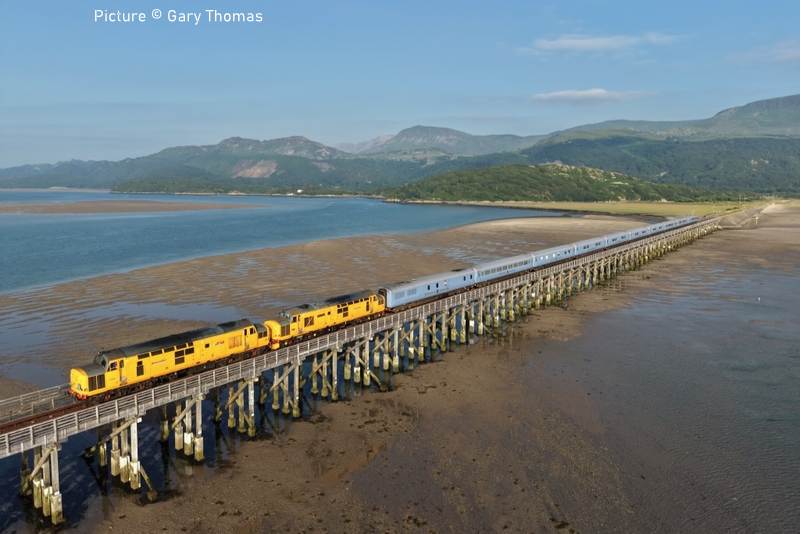
97 303 and 97 304 on the Belmond Britannic Explorer approaching Barmouth on Tuesday 23 June. Picture by Gary Thomas.
News Pictures
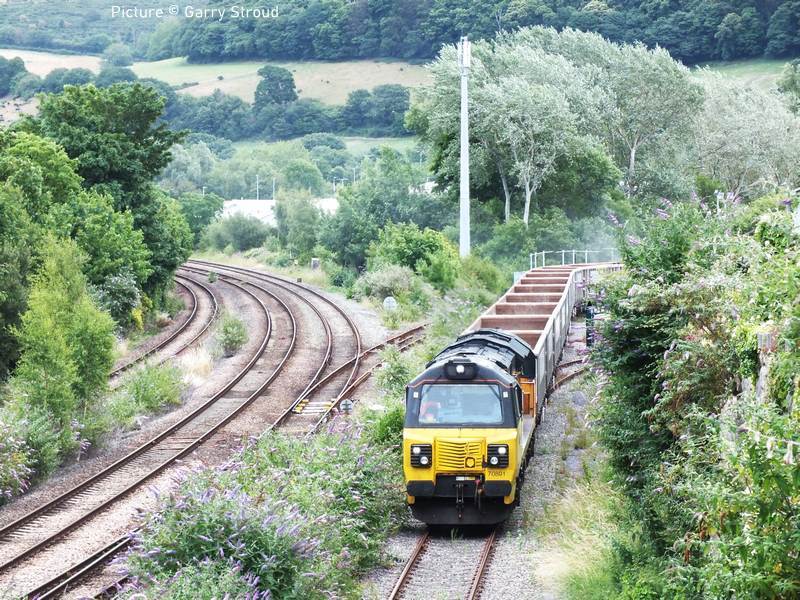
With the buddleia bushes taking over in Llandudno Junction, this view from Queens Rd bridge on Monday morning 29 June, shows 70 801 reversing the stone empties into Llandudno the compound after arriving with the 4D61 empties from Bradwell up sidings. (Garry Stroud).
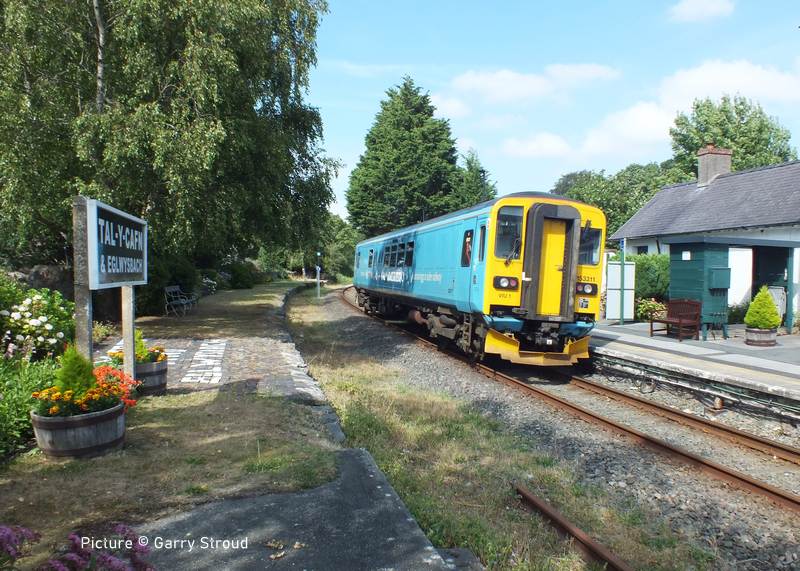
Adding a degree of colour to the Blaenau Ffestiniog branch, 153 311 (Video Inspection Unit VIU1) worked the 2Q60 Network Rail test service from Nuneaton to Llandudno and Blaenau Ffestiniog on 26 June. Seen on its return service from Blaenau, 153 311 passes the delightful Tal-y-Cafn & Eglwsbach station with its period nameboard as it heads back to Derby RTC. (Garry Stroud).
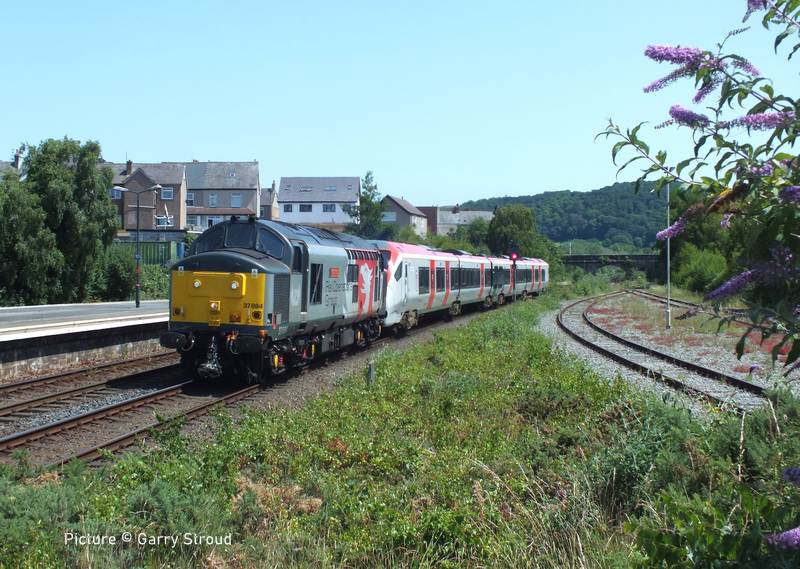
Working as 5Q40 on another 'unit drag' from Cardiff Canton to Holyhead depot's wheel lathe on 24 June. 37 884 Cepheus pulling 231 005 approaches Llandudno Junction station, recently cleared of undergrowth, this view from the end of platform 4 is now obtainable (Garry Stroud).
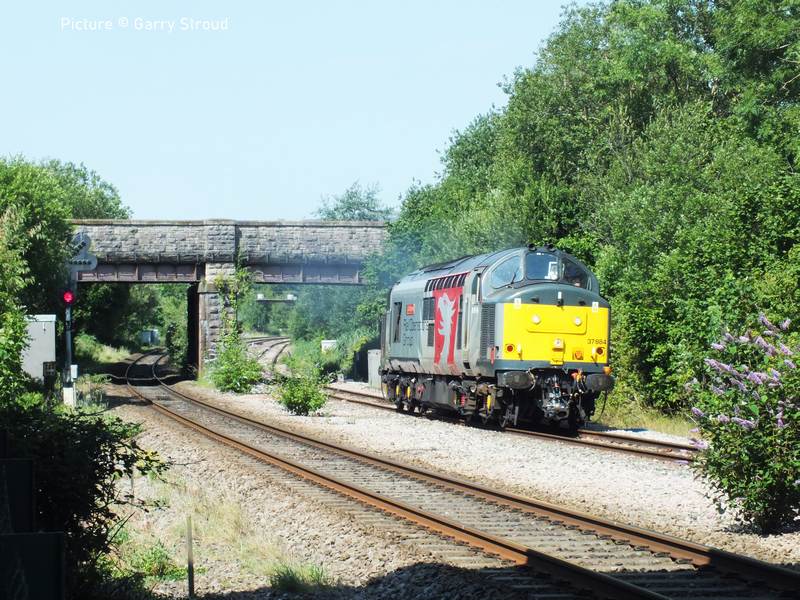
Also on 26 June, 37 884 departs Llandudno Junction past Pabo Lane with the light engine movement back to base at Railway Technical Centre in Derby (Garry Stroud).
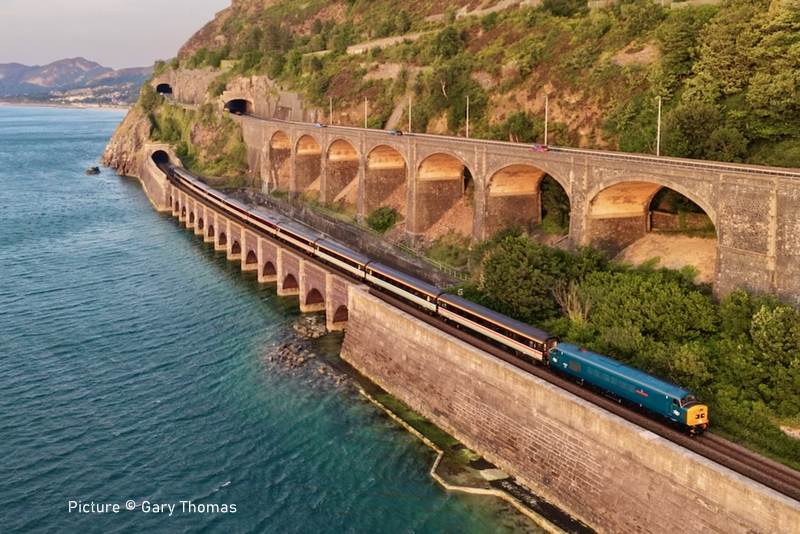
25 June saw the annual Three Peaks challenge, in which Snowdon, Scafell Pike and Ben Nevis with a chartered train taking them between peaks, via the closest station to each peak. Gary Thomas captured the train on the Pen-y-Clip viaduct. This year the traction was preserved Class 45 45118 which has recently returned to main line work, with Locomotive Services 57 311 on the other end.
The first train 'leg ' was 20:51 Crewe to Bangor, for a coach to Snowdon (the train continued empty to Holyhead for servicing). 57 310 was supposed to power the next leg, to Ravenglass. It failed at Llandudno Junction, which required 45118 to take the train forward. It became the first peak into Fort William the following day.
Unfortunately, things were not going well on the railway that evening. More problems ensued when the 1D89 18:25 Avanti service from Holyhead to London was declared a failure in Prestatyn station, blocking the route of the Three Peaks train. There is no crossover at Prestatyn, so 1D89 (805 007) which was running 47 late failed in Prestatyn. 'Wrong line working' was imposed for 1D32 Manchester Airport to Holyhead train. The Three Peaks train could pass the failed 805, thus allowing 1Z99 (Another 805) which was behind 1Z32 to couple to 805 007, push it to Rhyl and then reverse (as 5D89 to Crewe). After all this the challengers arrived just half an hour late at Bangor.
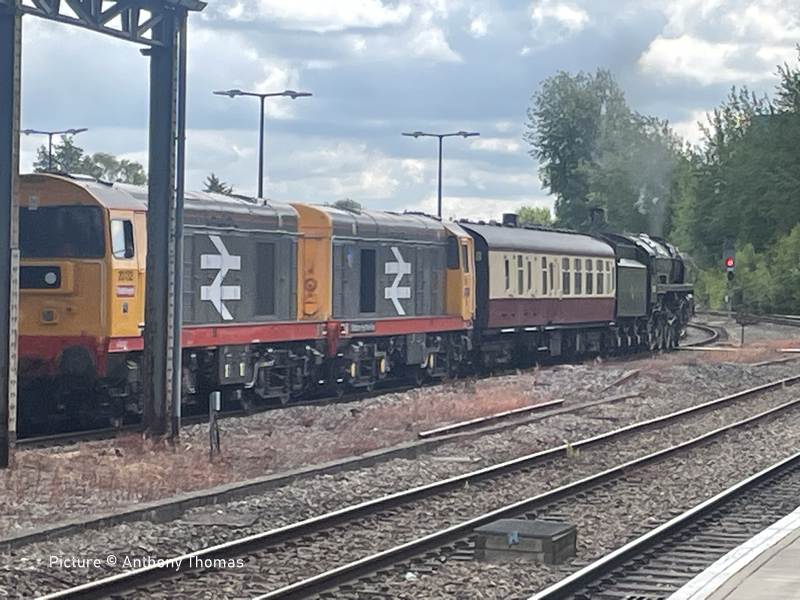
70000 Britannia + support coach + two Class 20’s on a loaded test run from Crewe to Chester on 16 June 2026. Presumably, Britannia is being tested for main line running following its failure at Oxenholme on 08 April 2026 due to overheating big end issues. (Anthony Thomas)
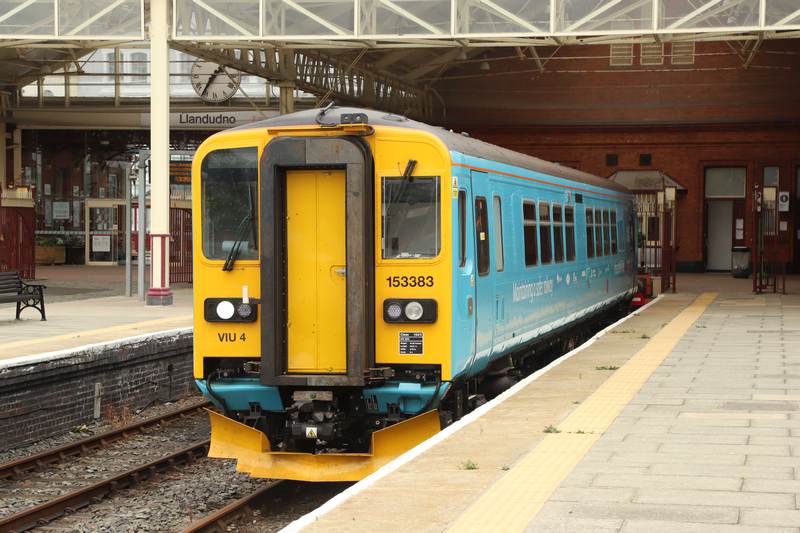
Another test run appeared on 2 July, only this time with 153 383 (VIU4), resting at Llandudno Llandudno platform 1 (Greg Mape). These trains use onboard cameras, lasers, and sensors to capture high-definition footage and structural data of the railway network.
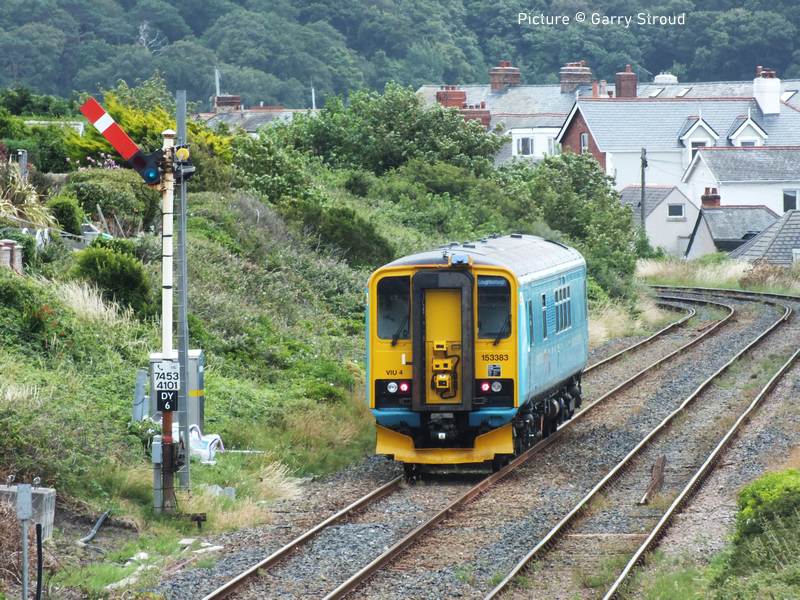
After visiting Llandudno the unit passes the semaphore
signal before approaching Deganwy station just around the
curve with the 2Q54 from Derby on its journey to Blaenau
Ffestiniog (Garry Stroud). Notice that the camera
equipment is fixed at one end only.
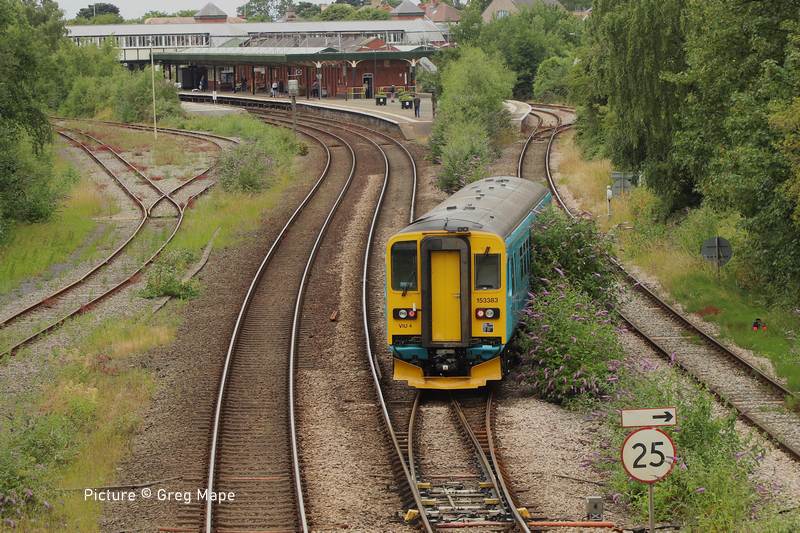
Returning from Blaenau Ffestiniog into Llandudno Junction station (Greg Mape). What can you say?
Returning from Blaenau Ffestiniog into Llandudno Junction station (Greg Mape). What can you say?
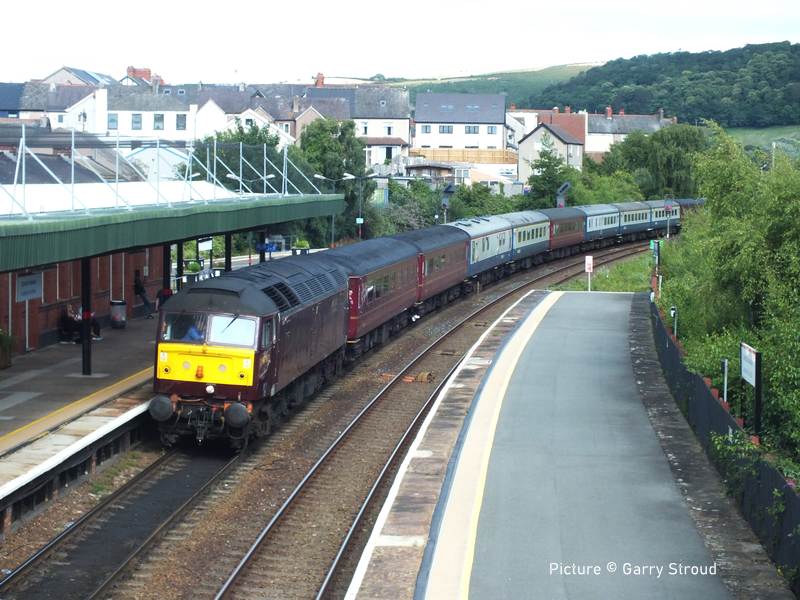
With a mixed rake of West Coast Railways stock 47
812 enters Llandudno Jcn, with the late running
1Z15 Saltburn to Llandudno charter. Friday 3 July. (Garry
Stroud)
Celebration Talks
Llandudno Museum, as part of the Rail200 celebration, has some rail related talks which may be of interest to readers. All are for approximately one hour starting at 1300, at the museum, 17-19 Gloddaeth Street Llandudno, LL30 2DD
21 July – Station Masters, Agents and Tickets – Philip Evans
4 August – Past, present and future of railway heritage in Wales – Dr Louise Moon (Transport for Wales)
11 August – Station Masters, Agents and Tickets – Philip Evans
27 August – History of British Transport Police – Bill Rogerson MBE (Secretary of BTP History Association)
Miscellany
Many thanks to the readers who identified the location of our 'stag' picture last issue. The view of a Hastings motor coach is Tonbridge. The train is on its' regular route, almost all of the Charing Cross to Hastings trains stopped at the exact position. The feather on top of the signal slants to the right and that signals the route to Hastings (straight on being Ashford).
South Wales news: the tram-train units are in passenger service. How will people manage on the long evening journeys up the valleys without toilets? You can guess.
Dog-box to the rescue! On 2 July the 04:20 1Y11 Cardiff - Manchester and 08:30 return were worked by 153 331 and 153 303 (Set AT03) instead of the booked loco-hauled set. The 08:30, one of the most popular services, reached Cardiff 30 minutes late. What's going on? We hear that a number of 197s of service are waiting spare parts, and/or the maintenance are taking 'industrial action' over pay. Looking back, of course, the 153s were originally built for use in this route, replacing loco-hauled trains before they were divided to make the current single-units.
Ffestiniog etc.
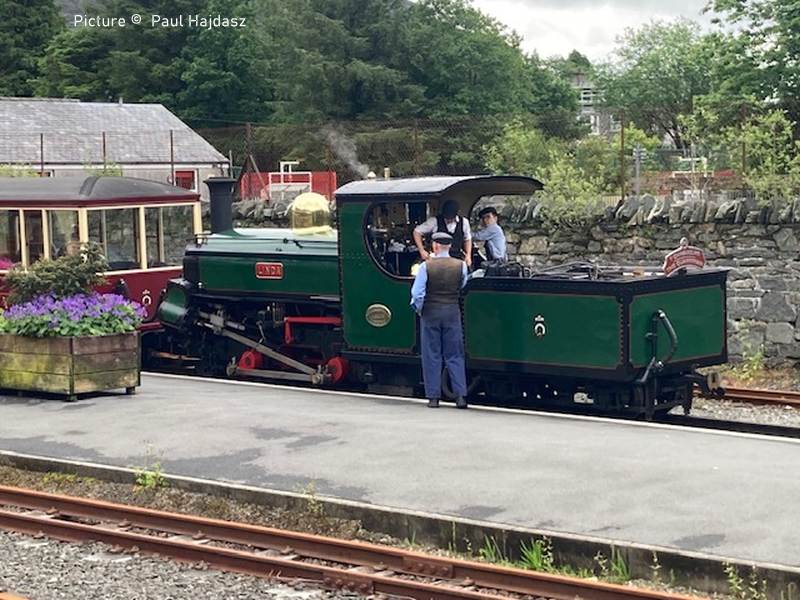
Paul Hajdasz writes: On Wednesday 17 June I bought a North Wales All Zone day rover, costing £29.95 with a Senior Railcard. I travelled to Blaenau Ffestiniog, where I saw Linda. It was built in 1893 by the Hunslet Engine Company for use on the Penrhyn Quarry Railway until 1962 when it entered service on the Ffestiniog Railway .
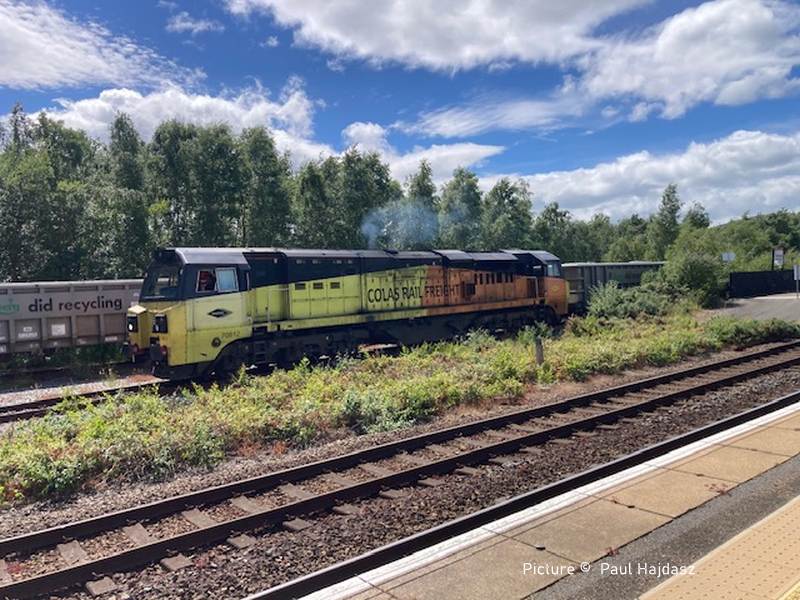
When arriving back at Llandudno Junction, Colas 70 812 was performing shunting duties of an aggregates train in readiness for departure of 6M66 to Bradwell Up Sidings. (Paul Hajdasz)
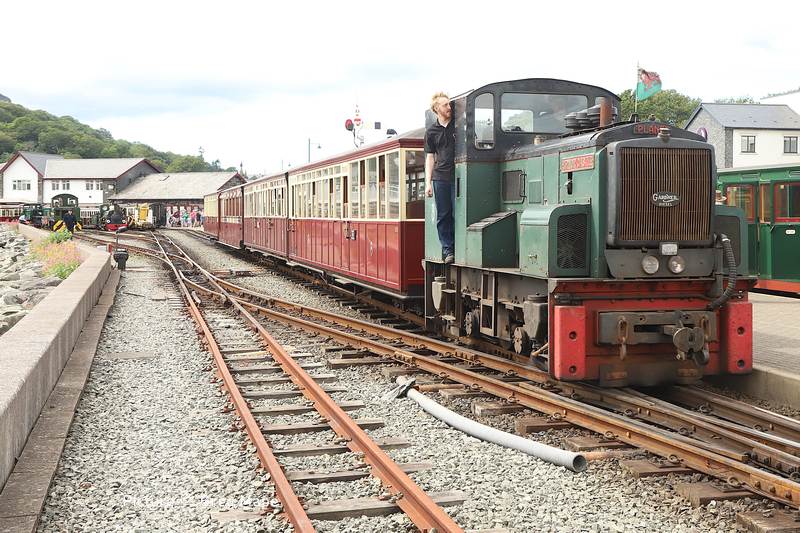
Porthmadog on 20 June in the Weird & Wonderful event'. For example diesel on passenger ...
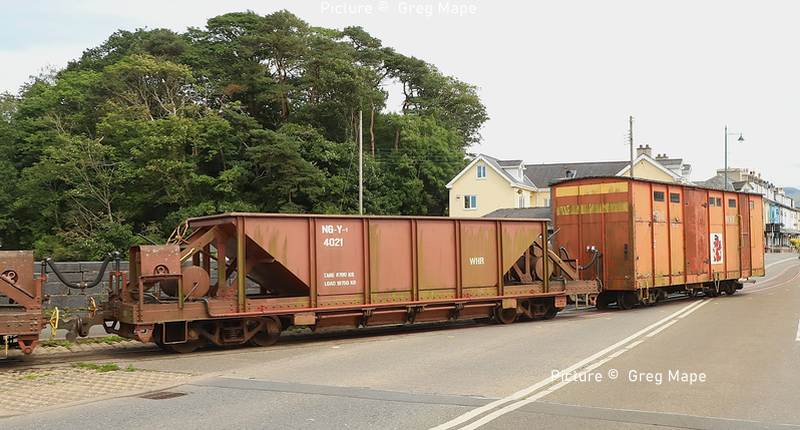
... Freight wagons on the main street ...
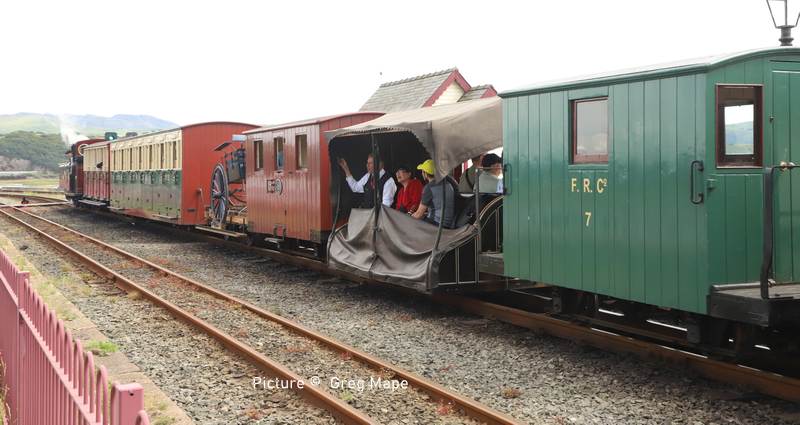
... a true weird train (Greg Mape)
Britannic action at Sutton Bridge, 26 May - report by Graham Breakwell
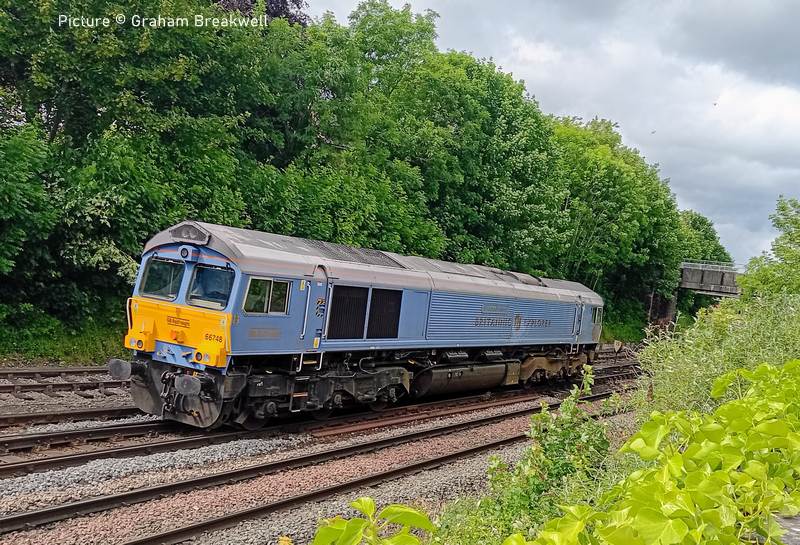
66 748 St Michael's Mount arriving at Sutton Bridge Junction after servicing at Bescot.
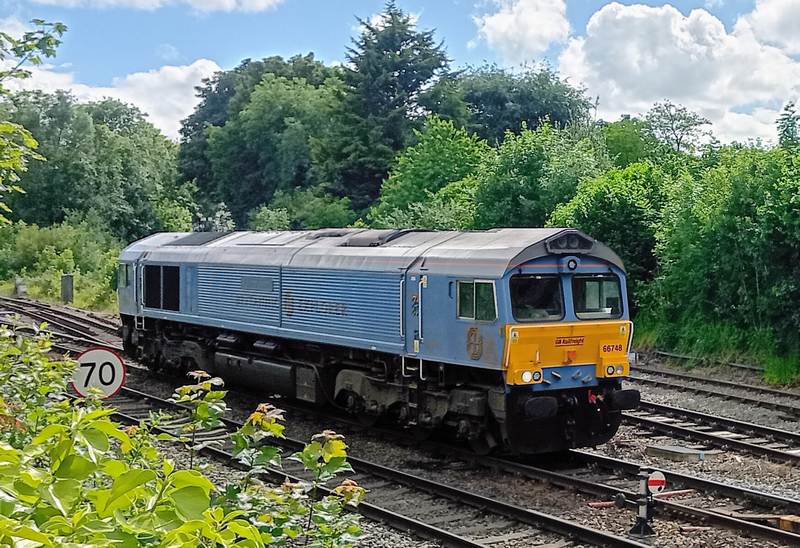
Then crossing over and heading to Shrewsbury station to take over the next leg to Oxford.
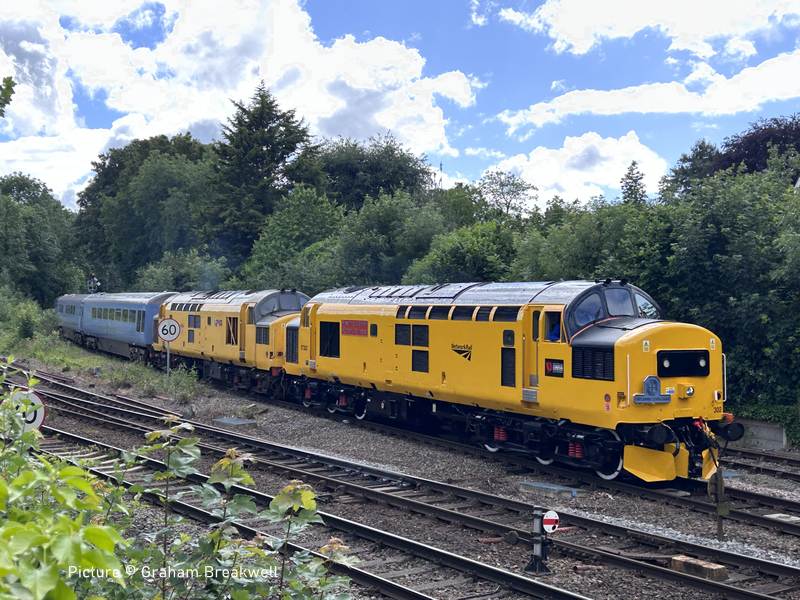
97 303 and 97 302 leave the Cambrian route with the Barmouth to Shrewsbury leg, 97 303 has just returned to service following a major depth exam, various reliability modifications and a full repaint – note the orange line under the windscreen and the white wheels. The sticker on the cab-side is new, it reads Rheilffyrdd Lleol / Cambrian Local Railways.
[Please can someone take pictures for us of the train on the Barmouth to Machynlleth section?]
From Dave Sallery's Archive
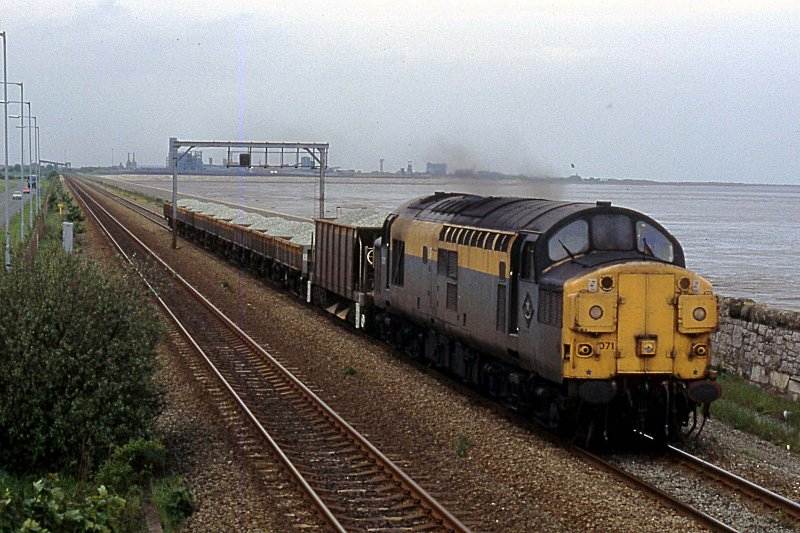
37 071 heads an Up ballast past Ffynnongroew, 30 May 1996.
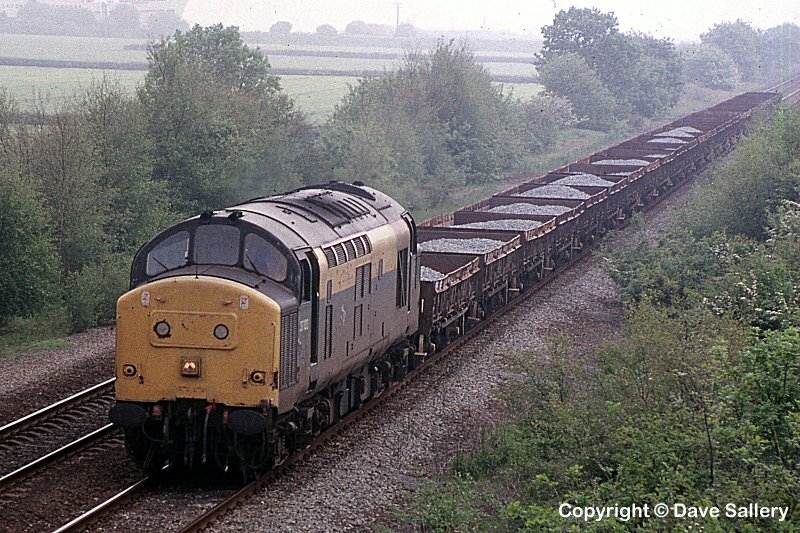
37 133 with ballast empties for Penmaenmawr near Mostyn. It was quite common for part loaded trains to return to the quarry. 15 May 1998.
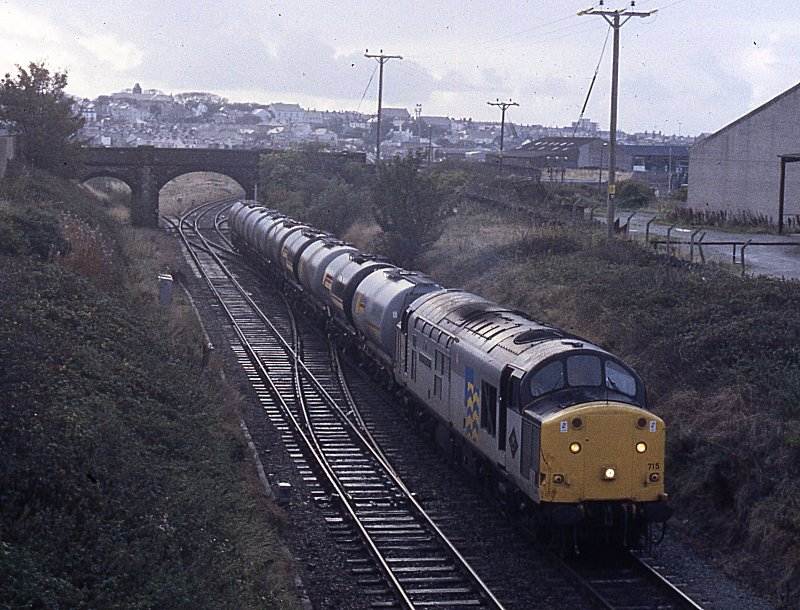
37 715 with a longer than normal empty fuel tanks train leaving Holyhead for Stanlow, 9 October 1993. The fuel oil was for BR traction use and now travels by road.
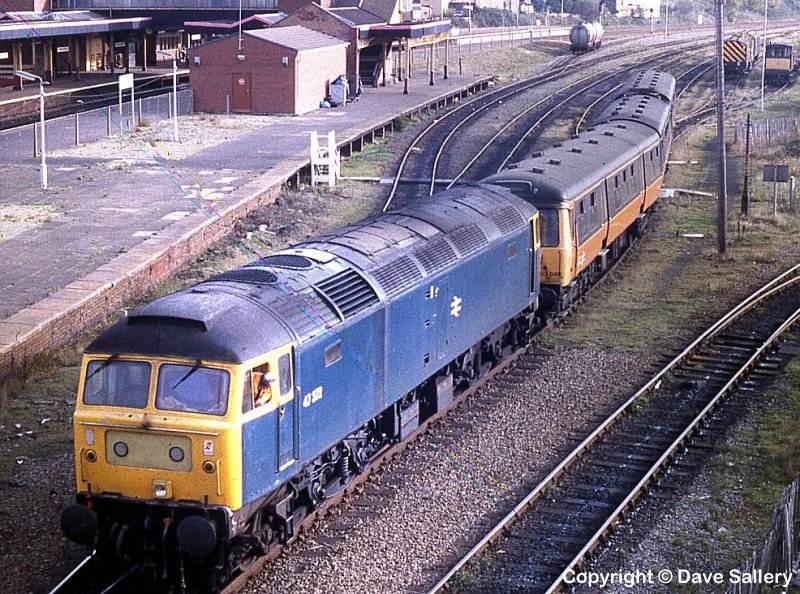
One time Glasgow Blue train No. 303 049 is seen being shunted by 47 372 in Llandudno Jct yard on November 5th 1991. The unit had been in store at Llandudno Junction for a couple of years since being declared surplus from the Manchester area. It was on its way to Clacton where it was converted into a test train for Network South East. 303 049 was renumbered to 303 999 and used by NSE until 1996 after which it was scrapped.
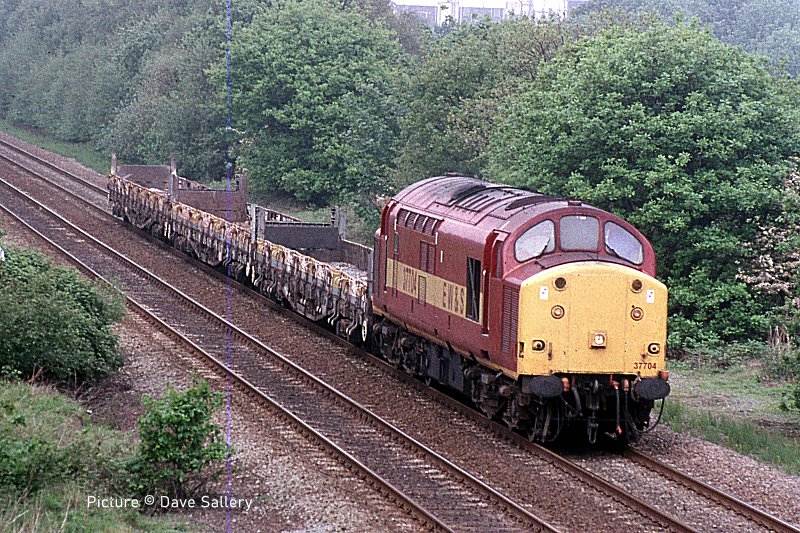
37 704 with a down engineers train near Mostyn, 15 May 1998.
Looking back: South West part 2 1971 - By David Pool
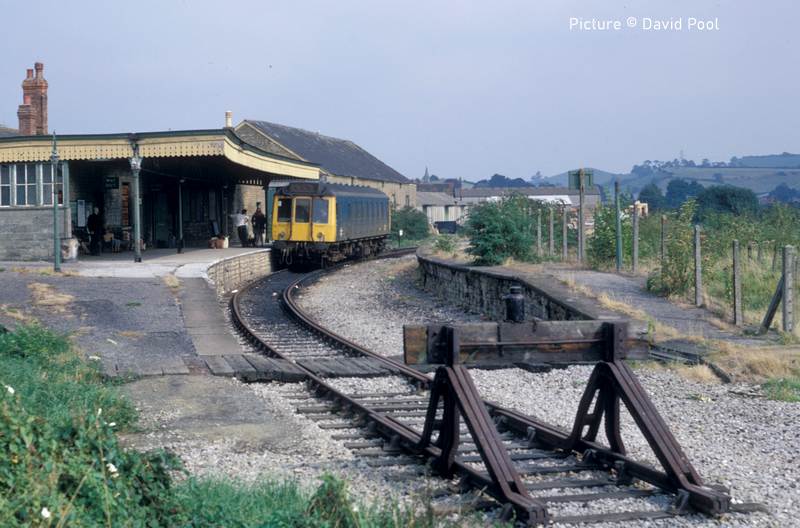
The Bridport branch in Dorset was still open in 1971, and on 19 September the 11:48 from Maiden Newton was a single unit W55034. Like most of the branches in Dorset and East Devon, there was no direct railway connecting the coastal towns. Lyme Regis was less than ten miles away on the coastal road, but the distance by rail would have been just under 50 miles, with changes at Maiden Newton, Yeovil and Axminster. The Bridport branch originally continued to West Bay, but was cut back to Bridport in 1930 and eventually closed in 1975.
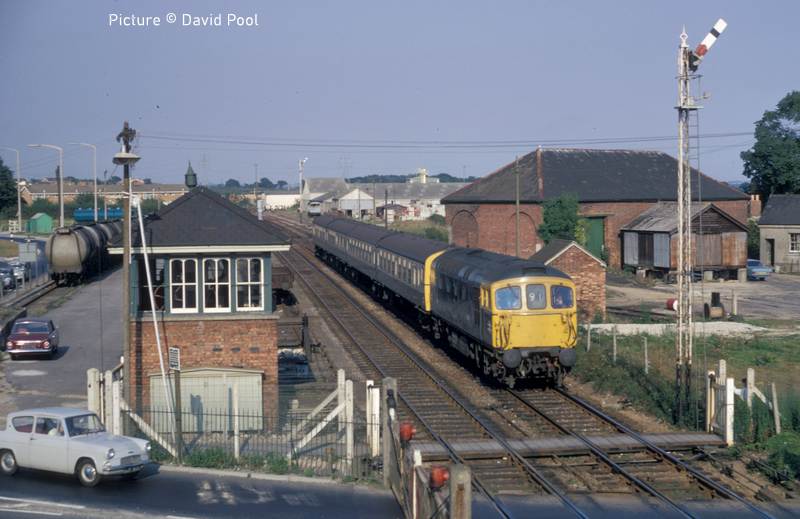
The Southern Region electrification had reached Bournemouth by 1967, but the extension to Weymouth was not authorised until 1986. Meanwhile the use of the 4TC units with a driving compartment at each end of the four car unpowered sets, together with a suitably fitted Class 33 Diesel locomotive, enabled the Weymouth portions of the electric trains from Waterloo to continue beyond Bournemouth. On 16 September 1971 the 14:30 from Waterloo was leaving Wareham behind 6536 (later 33 117).
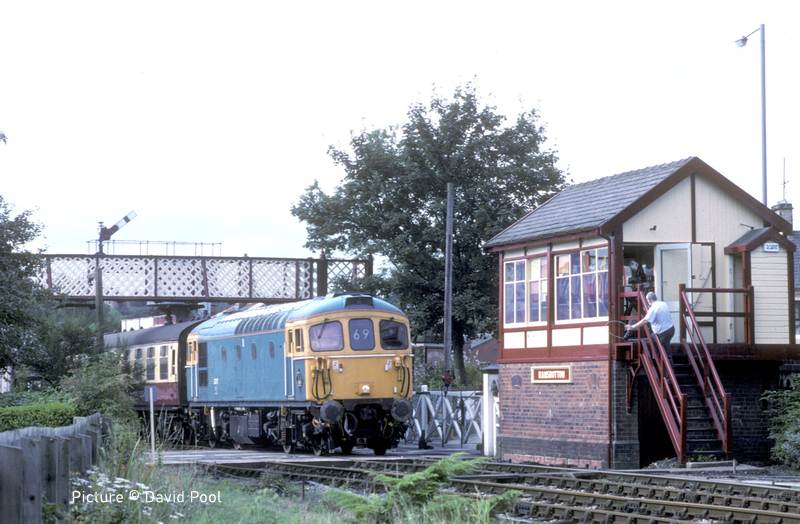
27 years later I photographed 33 117 again, now one of the East Lancashire Railway’s most useful locomotives. On 29 August 1998 it was leaving Ramsbottom. Today it is undergoing a major overhaul at Bury.
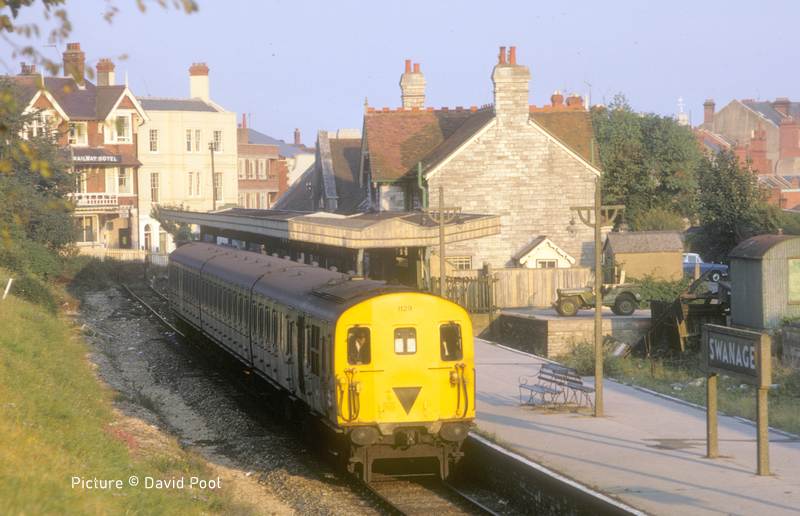
The Swanage branch was being operated by a “Hampshire” Class 205 diesel unit 1129. Swanage station had been reduced to a single platform with no run round loop, and would be closed within four months. A determined campaign to reopen the line as a heritage railway saw the first public train run on a short section of the line in 1972. Today the Swanage Railway is thriving, and particularly successful in making use of its connection to Wareham by hosting visiting steam and diesel locomotives at special events.
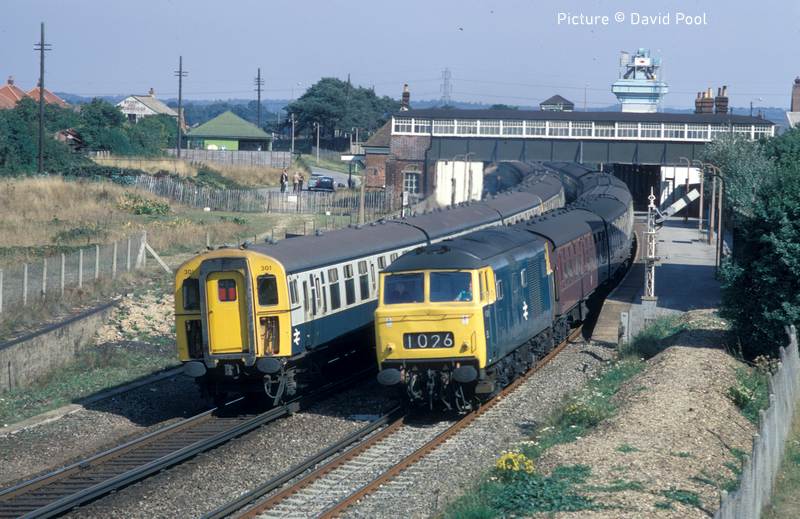
There are some interesting features in my shot of trains at Christchurch on 18 September 1971. Hymek 7026 was working the 09:30 Birmingham New Street to Poole, and I had mistakenly assumed that the headcode 1O26 had been an unofficial code showing the locomotive number. Seeing the same train a few days later confirmed that this was the correct headcode for an inter-regional train. The end coaches of the train heading for Waterloo were not a four coach 4TC set, but an earlier 3TC with the set number 301. These sets later had a coach added, and were then renumbered in the 4-TC Class 491 series.
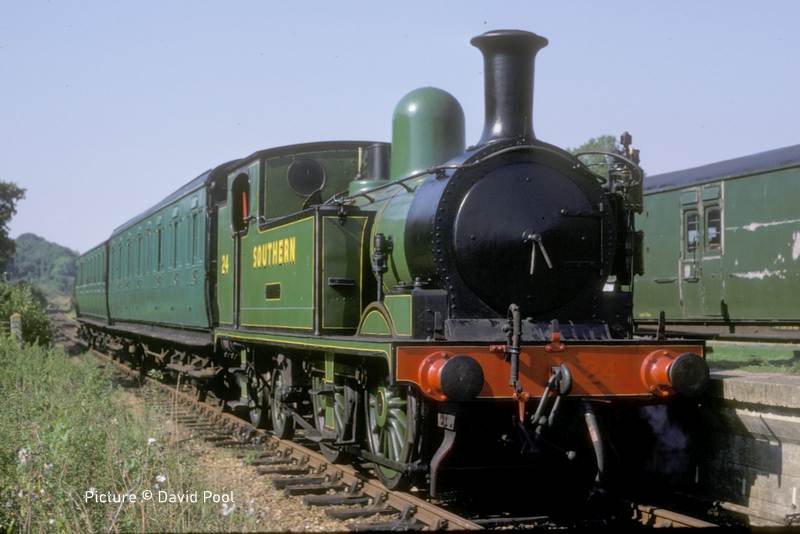
In 1971 on the Isle of Wight, the Steam Railway was now able to offer short rides from its Haven Street base. The sole surviving Class O2 24 Calbourne was in steam on 19 September.
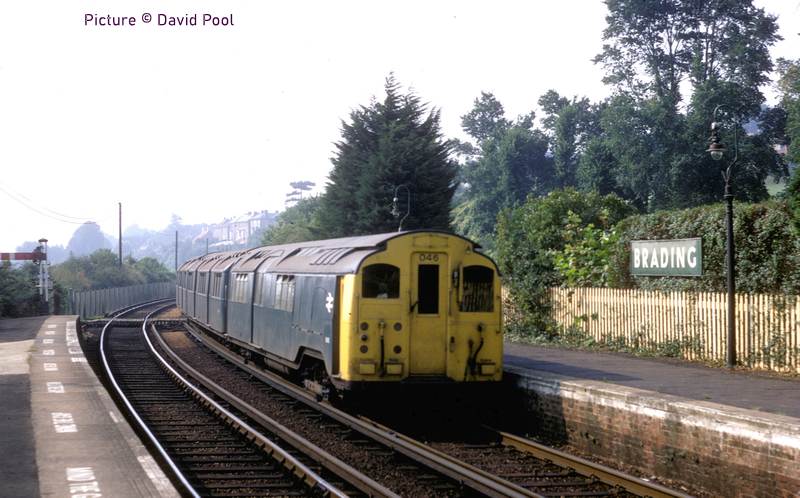
The line from Ryde Pier Head to Shanklin was now electrified, using the 40 year old ex London Transport “Standard” stock in the inevitable BR blue livery. A seven car train at Brading on the following day comprised a Class 485 4VEC plus a Class 486 3TIS (cars 8, 46, 49, 15 and 36, 96, 11, units 046 and 036). To add to the confusion, these were originally Class 452 and 451 respectively. Vectis was the Roman name for the Island.
The background to the use of the LT units is very well explained in this YouTube video.
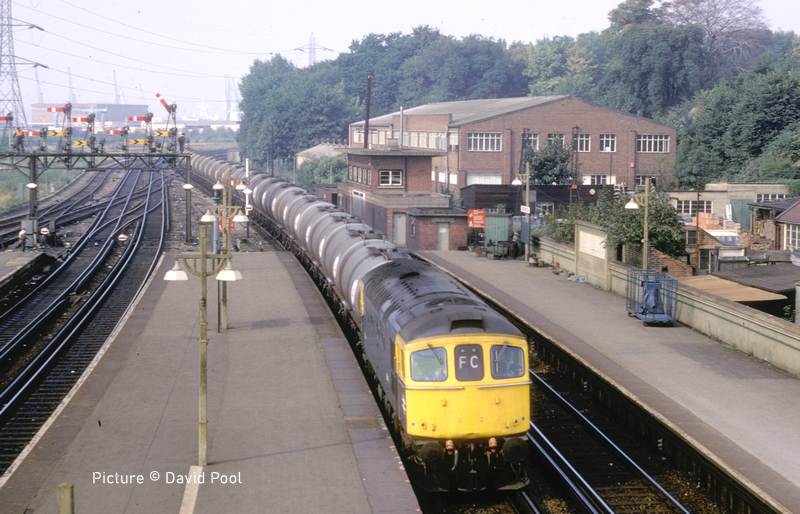
There was much to see at Southampton on 22 September 1991. A long freight train appeared - I assume from Fawley - hauled by 6540 (later 33 022). I think it would be was going to Eastleigh, and then probably to the Western Region (Tavistock Junction?). The FC Headcode might confirm this.
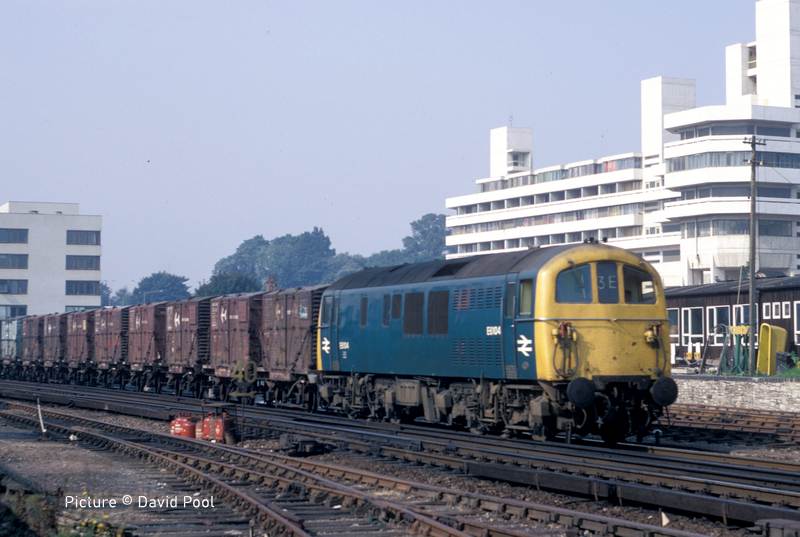
The next freight was particularly interesting, being an Electro-Diesel E6104 with a train of Conflats. The Headcode was 3E, and I would guess it had come from Southampton Docks. Any clarification would be appreciated.
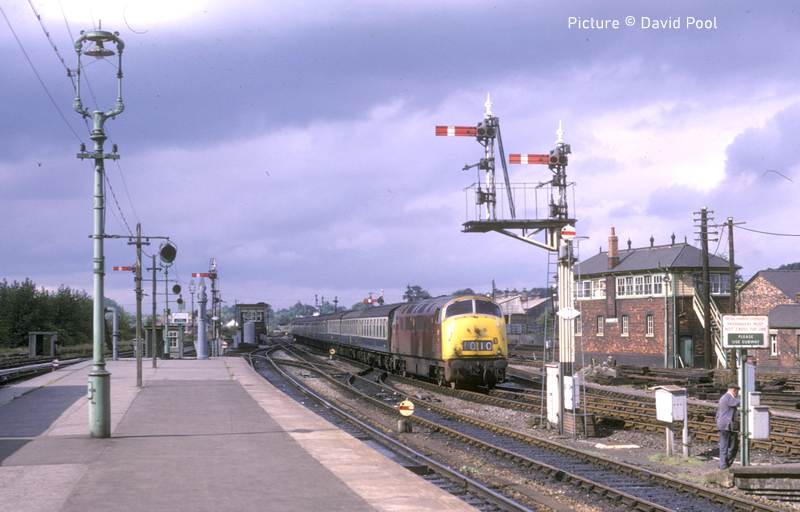
Returning home on 26 September, I called at Salisbury, where many of the trains to and from Exeter via the Southern Region main line were being hauled by Western Region diesels following the demise of steam haulage. Warship 817 Foxhound was arriving with the 10:15 Exeter to Waterloo, looking in need of a good cleaning. This must have been one of its last outings, since it was withdrawn eight days later.
Home page | Archive | Previous Notice Board